The Illinois consortium to advance English learner programming effectiveness is a grassroots effort of over 100 school districts across Illinois. The goal of the Consortium is to better understand the impact of EL programming on English proficiency, improve program quality, and to advocate for changes to state policy. IASA recently sat down with Dr. Jean Barbanente, Superintendent of DuPage High School District 88 and the lead representative for the Consortium, to answer a few questions.
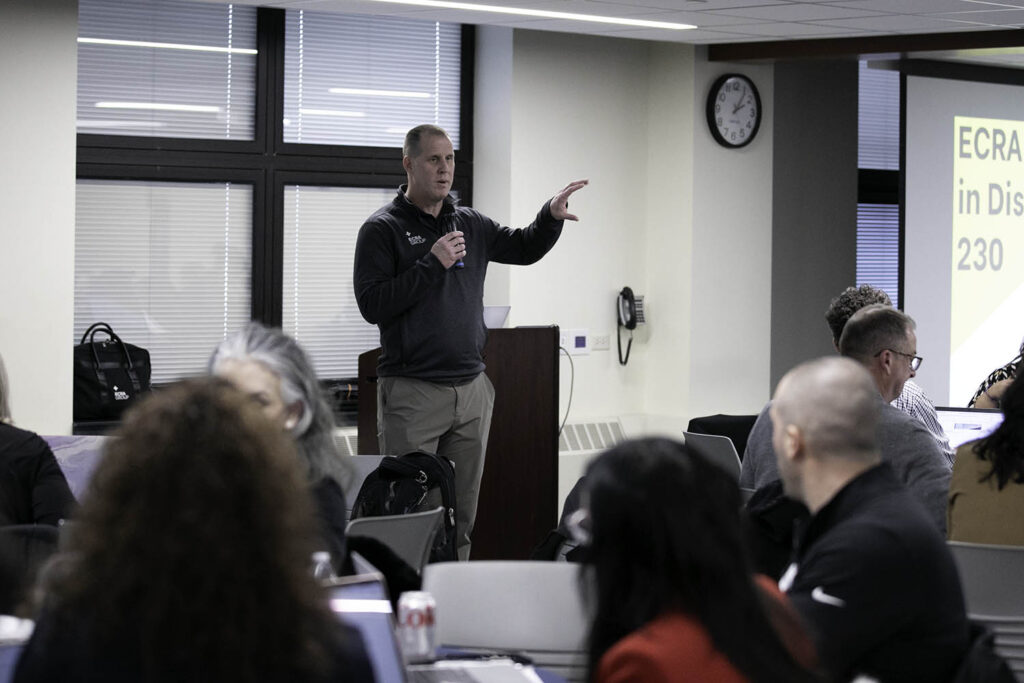
Adam Cibulka, Vice President of Client Success at ECRA, speaking at an EL Consortium event.

Charles Ovando, Assistant Superintendent of Student Services & Development at Leyden 230, speaking at an EL Consortium event.
The Consortium has three main objectives. One, to quantify the impact that various EL/Bilingual program models are having on English proficiency growth within local school districts. Two, to aggregate data across school districts to scientifically document what program models are most effective. We believe that local control of our EL programming is necessary to build high quality programs and the data from the EL Consortium could assist in those advocacy efforts. Three, to cultivate a professional learning community among EL professionals to share practices in the spirit of continuous quality improvement.
Absolutely. It is our hope that this study may provide valuable insights to guide future advocacy efforts around policies that would be aligned with positive student outcomes for English learners.
For years, school leaders have expressed concern about inconsistent and inequitable outcomes for EL students in Illinois. Districts have been required to provide costly services without clear evidence of their effectiveness. The Consortium was created to provide a structure to study the effectiveness of the Illinois endorsed EL/Bilingual program models to ensure English learners receive equitable and high quality services.
One of the overarching themes of Vision 2030 is to reform the mandate process to allow more local decision making and flexibility. EL related mandates are impacting school districts financially and operationally, with limited statewide evidence that said mandates are universally good for students. Vision 2030 advocates for reviewing existing requirements to make sure the benefits align with the financial and operational realities schools face. This is exactly what we are trying to accomplish with the consortium by raising awareness of EL program model effectiveness.
As leaders started to come together around these issues, it became apparent that we needed a trusted and capable data and research partner to help us accomplish our goals. ECRA has been a strategic partner to Vision 2030 and works with hundreds of local school districts across Illinois. They were the obvious choice given their deep understanding of Illinois education policy and their unmatched expertise related to data science and research.
In order to accomplish our goals, we need to work together as a community to document the impact of EL policy on local school districts and students. The EL Consortium will help leaders accurately analyze students’ outcomes disaggregated by program model, years in the program, grade level, school, etc. Districts will have the capability to drill down on the data to determine appropriate next steps and necessary program adjustments. Participating in the Consortium also provides districts local evidence of what is working for students in their community. The more districts that participate, the more we can learn about ourselves, learn from each other and advocate for change.
To become a member of the Consortium, click here. You can also contact Dr. Barbanente directly at jbarbanente@dupage88.net
As a community, we believe that local flexibility of EL programming is necessary to maximize student success. To that end, we have come together on behalf of students to assemble the necessary data sets to improve our practices, strengthen our programs, and advocate for more appropriate state policy. Our three objective are:
To analyze EL data across school districts in order to guide state and local policy.
To document the relationship between EL/Bilingual practices and student outcomes.
To cultivate a professional learning community among EL professionals to share practices in the spirit of continuous quality improvement.
