Why Illinois Needs to Revisit its Reclassification Policy for English Learners
Purpose
The purpose of this research brief is to encourage dialogue among practitioners and policy makers to challenge whether current state policy related to English proficiency benchmarks is meeting the needs of English Learner (EL) students. This document, published by the Illinois Consortium to Advance English Learner Program Effectiveness (the “Consortium”), provides meaningful and objective data to guide conversations as the Illinois State Board of Education (ISBE) considers changes to English proficiency benchmarks for EL students.
Context
The Consortium is a grassroots effort of over 100 school districts across Illinois. The goal of the Consortium is to better understand the impact of EL policy and programming on English learners and to improve program quality through evidence-based practices.
Illinois education policy is undergoing significant change related to student expectations and the definition of school quality.
August 2025
ISBE approved new “right-sized” student proficiency benchmarks on the Illinois Assessment of Readiness (IAR) and the ACT assessment in English Language Arts (ELA), Math, and Science to provide educators and families more meaningful data about student success.
April 2026
ISBE approved a new school accountability system, which shifts Illinois policy toward school profiles and fixed expectations for schools to ensure meaningful public reporting and to better support continuous school improvement for all schools.
Future
ISBE will consider new English language proficiency benchmarks for English Learners (EL), which has high stakes ramifications for EL students as English proficiency benchmarks serve as the exit criteria for reclassification of EL students to general education programming.
Given the high stakes ramifications of students meeting/not meeting the reclassification exit criteria, it is imperative that practitioners and policy makers examine whether the English proficiency benchmark of 4.8 on the ACCESS assessment of English proficiency has met the needs of EL students. It is the hope that data presented in this document can guide ISBE as they set new EL policy for the future.
Establishing English Proficiency Benchmarks
Research on exit benchmarks, referred to as reclassification, centers on the “Goldilocks Dilemma.” If the reclassification threshold is set too low, students may lose access to beneficial EL services. Conversely, if the threshold is set too high, students who no longer need English language support may be held back from accessing other learning opportunities. When exit standards are “just right,” reclassification has been shown to have a long-term positive impact on students.
Emerging research is raising awareness that there are negative effects for Long-term English Learners (LTEL) who never reclassify. LTELs are often deprived the opportunity to access the full range of academic programming, including college/career pathways and advanced AP and Dual Credit coursework at the high school level. Unreasonably high benchmarks also frustrate EL parents given the stigma and negative connotation often applied to LTELs, which inappropriately frames a student’s language acquisition as an individual learning impediment.
English Proficiency Levels as Measured by ACCESS
According to the WIDA Consortium, the publisher of the ACCESS English proficiency assessment, “an English language proficiency level is a measurement of where students are in the process of developing the English language skills needed to access content instruction in English.” In this report, the term “instructionally independent” refers to a student who can effectively access instruction in English without native language support. WIDA reports the following grade-level performance levels related to English proficiency.

WIDA reports English proficiency as a decimal. For example, a performance level of 3.5 represents a student that is “Developing” in language proficiency and is roughly half way to “Expanding.”
WIDA made significant changes to the ACCESS test for the 2025-2026 school year, and will initiate a standard setting process in July 2026 to establish proficiency levels on the new assessment. Data presented in this document is from the 2024-2025 school year, allowing for a clean analysis of the appropriateness of the current proficiency benchmarks, and presents considerations for Illinois as it sets new policy for the future.
What we know about the Illinois ACCESS Benchmarks
The Illinois State Board of Education (ISBE), not WIDA, sets the policy benchmarks for what is deemed proficient on the ACCESS assessment. There is a wide range for how states ultimately define English proficiency to support policy goals. Nearly all states that administer the ACCESS test define proficiency between 4.0 on the low end and 5.0 on the high end. Illinois defines proficiency on the higher end of the range with a benchmark of 4.8.
Methods
To examine the Illinois’ ACCESS English proficiency benchmarks, the Consortium conducted an analysis of over 43,000 English Learner students from 91 school districts across Illinois. The specific aim of the analysis was to:
Estimate the national percentile in Reading/ELA that an EL student would need to score on a nationally normed assessment of English native speakers to be deemed English proficient on ACCESS per Illinois policy.
Illinois policy currently requires a 4.8 proficiency level on ACCESS in order to exit EL programming and be reclassified as a non-EL student. A linking study was conducted on a matched sample of students that took both a nationally normed native English assessment in Reading/ELA and the ACCESS English proficiency assessment during the 2024-2025 school year. Non-linear prediction models were used to associate the national percentile in Reading/ELA needed to score a 4.8 on ACCESS.
Results
The following graph compares the rigor of the ACCESS 4.8 exit benchmark for English learners to the ELA proficiency benchmarks on IAR/ACT. For each grade, it displays the national percentile a student would need to reach to meet each benchmark. A higher percentile means the benchmark is harder to reach.
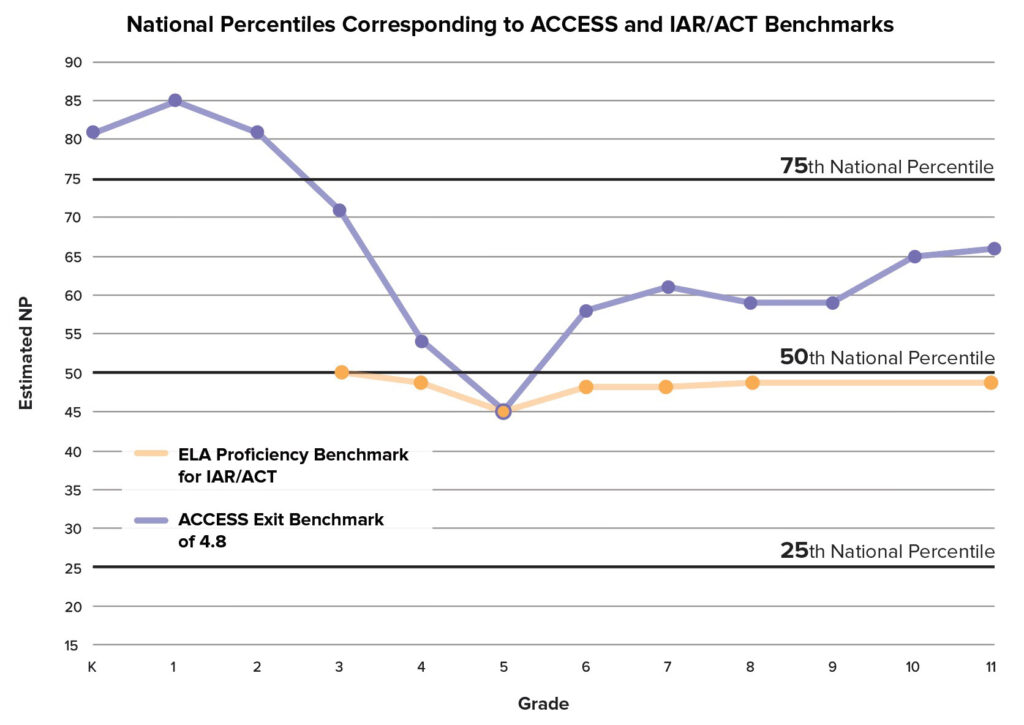
The results suggest the following:
The current 4.8 English proficiency benchmark is too high.
Overall, in order for an English learner to be deemed instructionally independent, and reclassified as non-EL per Illinois policy, an EL student must demonstrate English proficiency that far exceeds the average performance of native English-speaking students on nationally normed assessments of academic English. This finding suggests at most grade levels that the typical English native speaking student in Illinois would not be deemed English proficient on the ACCESS assessment.
It is much easier to meet the exit criteria in some grades than others.
A score of 4.8 on ACCESS corresponds to a national percentile, including native English speakers, as high as the 85th national percentile in grade 1 and as low as the 45th national percentile in grade 5. Grades 4 and 5 have the lowest standard for English proficiency, which explains why exit rates across Illinois are the highest in grades 4 and 5.
Guidance for Policy Makers
The policy question at hand is whether it is reasonable to require English learners to outperform their native English counterparts in order to exit EL support services and be reclassified as non-EL.
Based on these findings, the Consortium offers the following guidance to policy makers related to ACCESS proficiency benchmarks.
1.
Set the proficiency benchmark consistent with instructional independence, not aspirational academic English proficiency.
Benchmarks on ACCESS should be set with the sole purpose of determining when an EL student is ready to receive instruction in English without additional language support. Conflating instructional independence and aspirational academic English proficiency has resulted in the ACCESS benchmark of 4.8 being unreasonably high at most grade levels.
2.
Set the proficiency benchmark consistently for all grades by anchoring to a common national percentile.
The current ACCESS benchmarks are not well articulated across grade levels. It is much easier to meet the 4.8 benchmark in grades 4 and 5 than it is in earlier or later grades. Consider setting English proficiency benchmarks on ACCESS for EL learners between the 40th and 50th national percentile of native English speakers on nationally normed assessments. Currently, Grade 5 is the only grade that falls within this range. For context, the IAR and ACT proficiency benchmarks for academic proficiency in ELA, which is the standard ISBE has set for all students, is between the 45th and 50th national percentile across all grade levels.
3.
Monitor former EL academic English proficiency via IAR and ACT.
Right sizing the ACCESS exit criteria does not lower the standard for academic English proficiency. On the contrary, it decouples instructional independence from aspirational academic proficiency, two distinct constructs, to allow EL students access to a wider range of programming. Academic English proficiency should be measured by continuing to report former EL as a student group on state report cards for IAR and ACT to ensure former ELs reach the state standard for academic English proficiency.

IASA’s Leadership Matters Spotlights the EL Consortium